

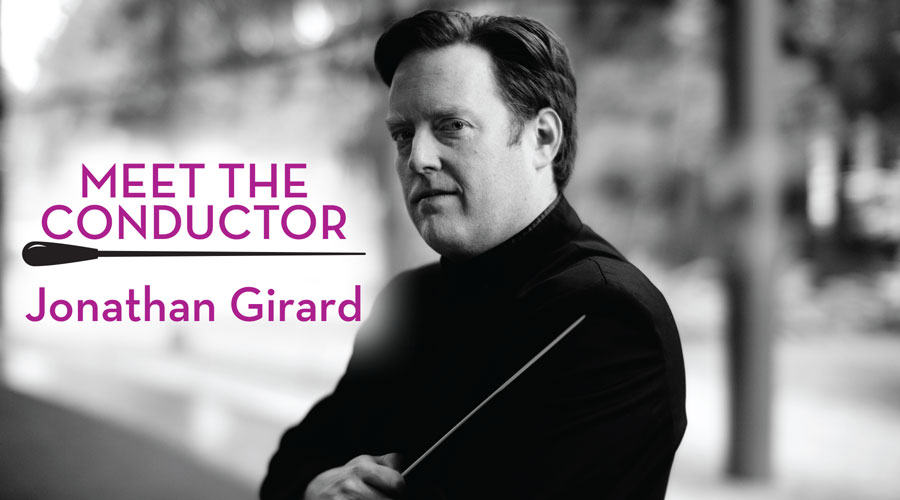
Meet the Conductor – Jonathan Girard
Q. What place were you born and where do you live now?
A. I grew up just outside Boston, in Massachusetts — New England winters and Fenway Park baseball summers. These days home is Vancouver, a very different kind of beautiful: lots of mountains and much taller trees, Pacific Ocean instead of the Atlantic.
Q. What is your favourite era/genre of music to perform?
A. That’s a hard one — whatever I’m conducting next is always my favourite thing! But I keep coming home to the late Romantics: Strauss, Mahler, Tchaikovsky – what appeals to me is something about the emotional scale of that music, the way it holds nothing back and every phrase is so satisfying to shape in collaboration with the orchestra.
Q. Who are your musical influences and what do you love about their music?
A. Leonard Bernstein is my largest musical influence. He’s my conducting grandfather, my teacher’s teacher, but I first was mesmerized by him as a kid, watching his Young People’s Concerts on TV. Watching him conduct and then turn around and talk about music with that same brilliance and warmth, I’d never seen anyone move between those two worlds so fluently.
Q. Your favourite food (only one!)
A. Valencian paella. My friend, Spanish clarinetist Jose Franch-Ballester introduced me to the paella and we have spent many happy hours while he perfected his paella technique here in Canada. The magic is in the socarrat, the caramelized crust of rice that forms on the bottom if you have the patience to leave it alone. Like orchestra it’s a group activity and to be enjoyed directly from the pan!
Q. Favourite book recommendation
A. Berlioz’s Mémoires. It’s one of the great firsthand accounts of what it actually feels like to be consumed by music. Berlioz was eccentric, highly opinionated, and led a vivid life. Because these stories are about his musical encounters, you will find many similarities with the struggles that musicians encounter today.
Q. Your most memorable performance? Where were you and who were you performing with and why was it memorable?
A. The last time I conducted Beethoven’s 9th with the UBC Symphony and Choirs at the Chan Centre. There was something almost otherworldly about that performance. The entire symphony felt like it happened in a single breath. The orchestra played with such extraordinary beauty, and the singers sang with such power. Every person who was performing was completely unified.
Q. Something unique or unusual about you.
A. Off the podium, I’m a licensed pilot — multi-engine and instrument rated. There’s something about flying that rhymes with conducting: both demand total presence, a feel for timing, and trust in your training when things move unexpectedly.
Q. How long have you been a conductor
A. ? I’ve been a conductor since I was in 5th grade, when I got my first chance to lead the very band I played in.
Q. What are you most looking forward to about performing with VIS this year?
A. I am looking forward to coming back to working with the musicians of the VIS again. They are such fine players, among them are many friends, colleagues, and even some of my former students! I’m especially excited to hear them all play Scheherazade.
Cleared for Take Off!
Conductor takes flight for Symphony’s Opening Night
Join us as we launch a ground breaking season unlike any other, featuring seven guest conductors, a new concertmaster, the addition of matinee shows, all taking flight with our opening concert, Arabian Nights. This vibrant performance takes place next Saturday, October 17 at The Port Theatre, showcasing a dynamic program that promises to captivate audiences and set the tone for an exciting musical season ahead.
Leading the performance is Maestro Jonathan Girard, the first guest conductor on the VIS season. Currently serving as the Director of Orchestras at the University of British Columbia, Girard is known for his generous musicianship and boundless enthusiasm on the podium. He also conducts the Athens Philharmonic, (Greece) and the Tokyo Opera Studio, (Japan). This marks his second appearance with the VIS, and he is excited to return to open the season. In a delightful twist, Girard, an avid commercial aviation enthusiast and pilot, plans to fly himself to Nanaimo for the performance!
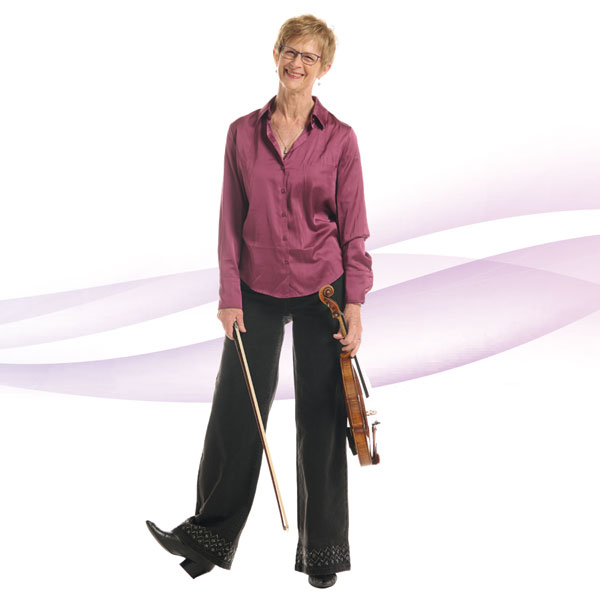
We are so thrilled this performance will also feature our new Concertmaster, Joan Blackman, whose exceptional talent will help convey the enchanting narratives woven throughout the program.
Highlighting both Canadian talent and classical masterpieces, this concert is not only a celebration of music – it is a celebration of our community and the stories that unite us.
The programme will burst to life with Alexina Louie’s Music for a Celebration — a vibrant, rhythmic spark that sets the tone for the season ahead. Brahms’ Variations on a Theme by Haydn follows – a masterclass in imagination and craft, transforming a single theme into a sweeping musical journey. The concert culminates in Rimsky Korsakov’s beloved Scheherazade, inspired by the timeless tales of One Thousand and One Nights.
Though each of these composers represent different eras and styles in classical music, there are interesting correlations among them.
Cultural Influence: All three composers were influenced by their cultural contexts. Alexina Louie draws on her Canadian heritage and Eastern influences, which is evident in her vibrant and rhythmic compositions. Brahms, rooted in the Romantic tradition, often incorporated folk elements and classical forms, while Rimsky-Korsakov’s work is steeped in Russian nationalism and folk tales
Romantic Tradition: Brahms and Rimsky-Korsakov are both significant figures in the Romantic era, though they approached composition differently. Brahms is known for his structural rigor and emotional depth, while Rimsky-Korsakov is celebrated for his orchestral color and vivid storytelling. Louie, while contemporary, is influenced by the Romantic tradition in her expressive style, creating a bridge between past and present.
Orchestration and Innovation: All three composers are notable for their innovative orchestration. Brahms’ Variations on a Theme by Haydn showcases his mastery of orchestral writing, transforming a simple theme into a complex tapestry of sound. Rimsky-Korsakov’s Scheherazade is a prime example of his brilliant use of orchestral color, bringing the tales of One Thousand and One Nights to life. Louie’s work demonstrates a modern approach to orchestration, incorporating diverse musical elements and textures.
While there is no direct personal relationship among these composers due to the differences in their lifetimes – Brahms (1833-1897), Rimsky-Korsakov (1844-1908), and Louie (born 1949) – their works can be seen as part of a broader dialogue within classical music, reflecting the evolution of styles, themes, and cultural influences across generations.
Arabian Nights takes place on Saturday, October 17th at 7:30 pm at the Port Theatre with a pre-concert talk starting at 6:30 pm.