VIS Donor Profile – Allan Gould

VIS Donor Profile – Allan Gould

VIS DONOR PROFILE
ALLAN GOULD

“The Vancouver Island Symphony is not just about beautiful music, it’s an important part of my life.” 

Allan Gould was born into a richly musical family. During his childhood in Kamloops, he not only played piano and trumpet, but was a boy soprano and had several lead roles in Gilbert and Sullivan operettas.

“My mom taught piano lessons, my sister played several instruments and my cousins all played piano and sang too. My dad played the violin, but usually only once a year at Christmas. Music was in all of us.”

When the Goulds moved to Nanaimo in 1995, they were looking for things to do. They were delighted to find the symphony performing at St. Andrew’s Church. The performances provided not only entertainment, but a social aspect for them. Allan remembers those hard seats in the church. “There was a VIS fundraiser where we could buy a padded foam seat for the church.  I actually found those old foam seats in the garage. They brought back great memories.”

Allan’s late wife Vera was very involved with the Symphony board, sat as chair, and was one of its biggest cheerleaders. When the symphony struggled, the Goulds were there to help.

“In those early years, it was important for us to donate so the symphony could maintain what it was doing. Now, as donors for more than two decades, our donations and support are there to allow the symphony to grow and be able to provide more concerts and events for our community.”

“If we were ever to lose our symphony, the effect would be nothing less than disastrous,” Allan stated.

“The symphony is a symbol of what this city is. If it can support a symphony, then if must be a very special place.”

Allan found another music lover in his second wife Diana. “We have enjoyed watching the symphony grow and gain momentum. They are an amazing group of talented, dedicated musicians. We are in awe every time we attend a performance. So many performances have driven us right out of our seats in celebration.”

Allan and Diana hope that their continued support of the VIS will result in its longevity. “It is all about the music,” says Allan, “It is money well spent.”

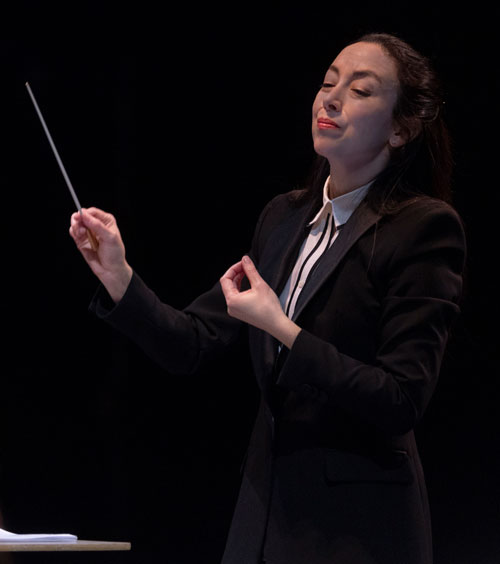
Meet Guest Conductor Cosette Justo Valdés

Meet Guest Conductor Cosette Justo Valdés

Winter Song Interview with Conductor Cosette Justo Valdés

Cosette Justo Valdés | Artistic Director Candidate

The VIS is excited to continue with their introduction of Artistic Director candidates. February’s Winter Song performance will feature their second candidate, conductor Cosette Justo Valdés.

Cosette was born and raised in Cuba and did not see her first Symphony performance until the age of eighteen. It was at that concert that she knew she wanted to be a conductor. “Conducting is more than making music,” explained Cosette “It is a great honour. For me it is about connecting with others – my colleagues and the audience. I decided to become a conductor because I love people and how they become their best when they are led with love. I have found my purpose in this career despite all the difficult obstacles I have had to overcome. Coming from a communist country that is truly a dictatorship, (although they try to make the world think otherwise) made me believe that conducting was going to be just a local experience, and that I was never going to have the opportunity for an international career. But here I am! I am incredibly grateful that I have made it to this beautiful country that has now become my home. Here I have found my people: some of my best friends and my most beloved colleagues,” said Cosette.

It is not surprising that one of Cosette’s favourite composer is Dmitri Shostakovich. “I have too many favourite composers! But one that has always spoken to my heart, and more lately, is Dmitri Shostakovich. He wrote exhilarating music that beyond having a perfect technique and creating new sounds and emotions, also transmitted a very strong message of protest and opposition to the government of Stalin. His bravery was beyond words.”

Cosette explained what it was like growing up in Cuba with her musical parents, who were both amateur musicians: “I grew up listening to music and making music with my parents, but they wanted a better future in music for me. It took a lot of work and sacrifices from my mother (who became a single mother before then) but she made it possible for me to study music at a boarding school that was a centre for arts. Those were very lonely years for me, as I missed her so much. I could only see her for two days every two weeks.”

“Since those early years, I have always been away from my family. I moved from my city Holguín, then later to study in La Habana, work in Santiago de Cuba, Germany, and now Canada. But my mother convinced me then that this was a necessary sacrifice for my future, for which I am now incredibly grateful. In Cuba, music is everywhere. Everyone is somehow a musician. And I am very thankful to be able to share my culture with the rest of the world,” she says with a smile.

Cosette goes on to tell us that she is enthusiastic about people and what we can do together as a community. “Their beautiful hearts and the meaningful things we can make happen when we work hard, with curiosity and inspiration but most importantly, together. I have been so inspired by the children, youth, and older audience members that come to talk with us after a concert and share about how this musical experience meant so much to them. Music and art save lives. We have a bigger responsibility, more than we sometimes suspect, especially in these times where our mental health has been so challenged. I see its importance more than ever.”

Last November, Cosette had her debut with the Saskatoon Symphony Orchestra. The program, which was titled “Mujer,” was formed by works of great composers that happen to be women. With the support of the SSO’s CEO Mark Turner, she was able to commission a piece by her colleague Evelyn Ramón. “She wrote an immensely powerful piece that portraits the reality of Cuba today, which is very sad. The experience of bringing this piece to life together with the SSO incredible musicians was a transformative one. During rehearsals, but mostly the performance, we were in tears together. The opportunity to share with the musicians and later the audience, so much about my country is something I will always be grateful for.”

Cosette is so excited to be in Nanaimo for this performance and she is already immensely thankful for this opportunity. When asked what being the successful candidate would mean to her, she shared her thoughts: “I can only imagine how I will feel if I become the Artistic Director of the VIS. It would be such an honour, and the possibility to dream big for this fantastic group of people and of course for myself along with them would be a dream come true.”

Join us for Winter Song.
Saturday February 11, 2023  |  The Port Theatre, Nanaimo | Preconcert Talk: 6:30 p.m  |  Concert:  7:30 p.m.
Sunday February 12, 2023  |  The Sid Williams Theatre, Courtenay  |  Concert: 2:00 p.m.

VIS Artistic Director Search

VIS Artistic Director Search

VIS Artistic Director Search

Over the past few weeks, I have been asked about the process the hiring of our new Artistic Director.

When Pierre Simard announced that he was heading back to Montreal in the spring of 2022, the VIS Board started preparations for his replacement. First up, we formed a Search Committee and Margot Holmes, VIS Executive Director posted the position.

The following identifies and answers a few common questions related to the current Search.

Who sits on the Search Committee?

Five 5 VIS Musicians (3 chosen by the orchestra and two appointed by the Board); two 2 Board Members; one (1) Audience Member and the Executive Director.

Who picks the music for the guest candidate conductors?

The music for all concerts is identified and approved in the winter/spring of the preceding concert year. In the case of the 2022/23 Season, Pierre Simard picked some of the music however, much of the music was selected by Calvin Dyck, Artistic Manager for this season and members of the Artistic Committee made up of musicians from the Orchestra and the Executive Director. The music picked for the candidates is a “test” programme where each will conduct a major symphonic work, a concerto and a contemporary piece of music.

How did we get to our short-listed candidates?

The Search Committee spent a considerable amount of time reviewing 36 applications for the Artistic Director position (it was rewarding to know that there was considerable interest in the position.) After reviewing videos, CV’s and other material, the Search Committee met to identify a short-list of potential candidates using a detailed process to evaluate and identify the candidates.

Why are the candidates conducting performances that are spaced out?

Once the Search Committee had identified its preferred candidates, there were three dates that could be used for these performances: October, January and February. In November we had a small orchestra and we would not offer a candidate a Christmas show as typically this music is easier to conduct.

How will a decision be made?

The Search Committee has developed a detailed process for determining a preferred candidate. That process includes our VIS musicians providing feedback through a questionnaire and non-musician Search Committee Members attending rehearsals, pre and post concert talks and meeting with the candidates over breakfast or lunch. There is a face to face interview with each candidate. Once the candidates have performed, the Search Committee will convene a Selection Committee meeting to collectively determine the preferred candidate.

We started with three candidates however one candidate withdrew their name and we now have two candidates for the position: Nadege Foofat and Cosette Justo Valdes.

It is a very exciting time for the VIS!

On behalf of the VIS Artistic Director Search Committee,

Dave Witty
President, Board of Directors

Christmas Memories – VIS Musicians share their musical memories

Christmas Memories – VIS Musicians share their musical memories

Christmas Memories
VIS Musicians share their musical memories

The music of the Christmas season is probably the most powerful for memories as we reminisce about family, friends, and Christmases past. The Vancouver Island Symphony will be once again be filling the theatre with beautiful music of the season to bring those wonderful memories, new and old, flooding back.

The VIS musicians always look forward to the special December performance every year. Many of them have special memories of performances past and family get togethers, so we asked them to share with us.

“My favourite Christmas musical memory will always be my Dad leading Christmas Carols from the family piano, usually with large groups of family (I have a lot of cousins in Vancouver) or friends singing in the way people only can when they know the music by heart. We sang them all: The Sacred (Angels We Have Heard on High, Silent Night), The Crooners (Chestnuts Roasting on an Open Fire), and the Ridiculous (I’m Getting Nuttin’ For Christmas). Many of these we still sing, my kids now learning all the words by heart,” shared Mark Beaty, Principal Double Bass.  “But the strongest musical memory, or maybe musical association I have with Christmas is Handel’s Messiah. I simply never get tired of hearing this masterpiece, probably in part because it is infused with all the other cozy Christmas traditions that filled our home: decorating the tree, games, my mom’s Christmas baking, my hilarious siblings, and if we were really lucky, just enough snow to go sledding, which in Vancouver was basically a Christmas miracle.”

Calvin Dyck, Concertmaster and Guest Conductor for the Christmas Memories performances shared some of his favourite memories. “I have so many memories of Christmas, from the year the power went out for 3 days and we heated up soup in a can by the fire and built mega snow forts in the yard. My brother and I used ice cream buckets to make “snow bricks” and then constructed forts with walls so high that we were completely hidden behind the walls, laughed Calvin. Then there was the Christmas Eve tradition at church where every kid got a goodie bag with peanuts and candy and of course a Christmas Orange! Our epic family gatherings always had to have two tables. One in the dining room for the adults and one in the kitchen which was designated as the “kid’s table” for us and all the cousins.”

Calvin explained that as a professional musician, the weeks leading up to Christmas seem to be the busiest time of the year. It seems that every organization in town is having a Christmas event. There are Christmas recitals, company parties, and special concerts. “Some days I could be in three places at once if I could clone myself,” grinned Calvin.

“But my favourite memory is of the music. The beauty of an acapella “Silent Night” at a candlelight service on Christmas Eve is spine tingling. There is this feeling of peace and hope that comes over everyone as we celebrate the prince of peace,” said Calvin.

“A special memory for me as a child was going to the “Christmas concert” in France which would be when the orchestras splurged on large symphonies and performed great pieces. Impressive size, sounds and the best kind of Christmas memory!” Shared by violist Guyonne Le Louarn.

Heather Walker, French Horn, shared this favourite memory: “The one thing that comes to mind is the one year that I ended up playing 26 Christmas concerts in the month of December. As a freelance musician with different orchestras, we are often engaged by many different groups. In addition to the VIS, that particular year I also played with the Vancouver Symphony, the Vancouver Opera orchestra, Kamloops Symphony, Christmas at the Chan, and The Nutcracker. Definitely a full month of Christmas music! So much fun!” laughed Heather.

The Vancouver Island Symphony will present the magical music of Christmas with a wonderful collection of holiday memories.  This year’s performances are sure to delight – from favourite carols and songs, to exerts from the Nutcracker. The program will include familiar carols such as O Come All Ye Faithful, Jingle Bells, O Holy Night, and Feliz Navidad. “The Island Consort, directed by Bruce Farquharson, will lead the audience in sing-along carols. They will also present an 8-part arrangement of “In Dulci Jubilo”, and the spine-tingling “Hallelujah Chorus” from Handel’s Messiah.” Calvin shared.

“It is a great honour to conduct the Vancouver Island Symphony. I have such respect for my colleagues, and their wealth of experience. The act of making music together is truly transformational, and I am thrilled to share this special Christmas concert with the Nanaimo audience.” explains Calvin.

Be a part of the tradition and join the Vancouver Island Symphony for a one-hour show (No Intermission) on Friday December 2nd at 7:30 p.m. the Tidemark Theatre and Saturday, December 3rd at 5:00 p.m. and 7:30 p.m. (2 shows) at the Port Theatre and get into the holiday spirit!

Bring your family and friends and create a new memory or reminisce and celebrate the beauty of the season.

Article written by Christine McAuley

Seasons of the Sea Interview

Seasons of the Sea Interview

Seasons of the Sea
Interview with violinist Joan Blackman

The beauty of the seasons is something everyone can appreciate and connect with. On November 5th, the Vancouver Island Symphony is pairing the timeless masterpiece Vivaldi’s Four Seasons with violin solo Joan Blackman with the contemporary, cross-cultural collaborative work Seasons of the Sea for an unforgettable evening of music and storytelling.

Joan Blackman, violinist

Joan Blackman, violinist

Seasons of the Sea, with music composed by Jeffrey Ryan and text by Rosemary Georgeson (Coast Salish and Sahtu/Dene Nations) describes the seasons on and by the sea. The words are inspired by the 13-moon season of the Coast Salish peoples who lived in harmony with the tides and the life each season would bring. This amazing piece of art which is woven from equal parts music and First Nations storytelling is a heartfelt collaboration that began back in 2016. “It happened almost by accident, and I had no idea how much it would move me,” recalls Joan Blackman, guest artist. “I credit my husband Larry for putting the bug in my ear about this project. It was the 30th anniversary of the Vetta Chamber Music (of which Joan is the Artistic Director) and we wanted to do something special. Larry had just heard Rosemary Georgeson on the radio. At the time she was the Storyteller in Residence at the Vancouver Public Library. Larry told me he was moved by her fabulous voice and the idea was born to approach her for a possible collaborative commission for Vetta Chamber Music.

Rosemary Georgeson, Narrator

Rosemary Georgeson, Narrator

“I contacted Rosemary and we arranged to meet. I invited along composer Jeffrey Ryan, who I first got to know when he was the Composer-in- Residence at the Vancouver Symphony. We didn’t know what we were going to create, and to tell you the truth, I was scared to death! Rosemary was not really into classical music, being more of a rock fan, but was eager to be involved,” laughed Joan.

After much discussion, both Rosemary and Jeffrey went off to create and write out their ideas independently of each other. “Then we workshopped it together as a three-some and wove the two artforms together which became an exploration of so many things.”

Yariv Aloni, Guest Conductor

“Rosemary and I then did a tour, meeting Elders from various coastal nations, and asking permission to include their stories in Rosemary’s text. We then fine tuned it and premiered Season of the Sea on Salt Spring Island including one performance where kids from Penelakut Island were in attendance. They had never heard Vivaldi’s Four Seasons before, but they were enthralled, and the Elders were very moved by the storytelling mixed with the Seasons of the Sea music and it was wonderful for all to experience.”

Our performance with the Vancouver Island Symphony on November 5th will be the first time Seasons of the Sea will be performed as an orchestral version. In the original form it was done with a string quintet only.

“I am passionate about this piece because it is so relevant to our time and speaks to today’s issues of reconciliation and our environment. My dream is to take it to places all along the Coast and share it with everyone. Nanaimo will be the very first stop.” Joan hopes that the audience will have an important take away from the concert… that through music and story it is so much easier to build bridges and open the lines of communication. The message of the two artforms combining and how they worked it out together is a way of finding reconciliation.

Join us for Season of the Sea this Saturday November 5 at The Port Theatre, 6:30 p.m. Pre-Concert Talk with the Artists; 7:30 p.m. Performance.

Article written by Christine McAuley

A New World – Interview with Conductor Nadège Foofat

A New World – Interview with Conductor Nadège Foofat

A New World Interview with Conductor Nadège Foofat

The Vancouver Island Symphony is getting ready to launch its 28th season entitled variations with a number of changes and surprises in store for music lovers. One major variation is a season with six guest conductors with three conductor candidates vying for the position of Artistic Director beginning in our 2023-2024 season.

We spoke with Nadège Foofat, who will be the first candidate to conduct the VIS on October 22. We asked what it would mean to her to be chosen for the position of Artistic Director. “Becoming the Artistic Director for the Vancouver Island Symphony would be a very symbolic coming home for me. While I am so fortunate to have had the opportunity to conduct orchestras and forge partnerships in other parts of the world, being the music director of the VIS would allow me to explore my passion for championing Canadian composers and repertoire” explained Foofat.

Curious as to how Nadège was drawn to music and especially why she chose the path of conductor, we asked her to describe her journey. “I don’t ever remember a time before music was central to my life; I have been told that I begged for a violin as a toddler until my mother gave in, at age three. I would go over to the family upright piano, crawling up onto the seat and would improvise, just to figure out how the notes worked and explore how the sounds went together. (Yes, my parents would ask me to stop!) Music was my first language in many ways; I was interested in composing before I could read music, so I’d jot down alphabet letters and symbols to map out pieces.” Nadège explains.

She was fortunate to have been exposed to great live performances of classical music as a child. Around the age of six, her mother took Nadège and her two older sisters to a season of the Calgary Opera Company. “I can still remember the productions of Magic Flute and Carmen. My parents could only afford the seats up at the top of the theatre, but that turned out to be lucky for me, because it meant that I could have a clear view of the conductor. And that is when I decided that conducting was what I wanted to do when I grew up” Foofat reflected.

Foofat studied violin and piano through her childhood but hearing the viola up close for the first time at age eleven started her on a new path. “It was such a trans formative experience, like recognizing my own voice. Though my mother was disapproving, I found a large old violin, strung it up as a viola, and started experimenting. “I taught myself to read alto clef and started playing viola secretly on the side. Fast forward two years, and on a lark, I auditioned and was accepted to the National Youth Orchestra of Canada as principal viola when I was fourteen. It was an incredible experience, as I had never even played in a full orchestra, and it was life changing to play under the baton of Kazuyoshi Akiyama.”

Her evolution from player to conducting was not without its challenges. “All along the way I was told that I should be a player, and that conducting was out of reach. (Hard to believe today!) I remember one of my most supportive teachers, who was a conductor, saying that women’s brains were different, and could never understand a score the same way as a man. That was a devastating thing for a young aspiring female conductor to hear, and part of me believed it for a long time! It took me until I was already a member in a professional orchestra to realize that I had everything I needed to pursue conducting, including the invaluable experience of having been an orchestral player and learning the trade from the inside.” said Nadège.

It comes as no surprise that Nadège is an advocate for equal representation of women in orchestral concerts. “Conductors are in a unique position of being the curators who choose what music gets to come to life and be performed. For me, this means when I program a concert, I program not only from the great classical canon, but an array of voices, and make sure that the representation that is happening is not just token.” What Foofat means by this is that the women and minority voices are not just given five minutes of playing time out of 90 minutes of music on a concert. This will include looking at a whole season and beyond, evaluating who the composers are, who the soloists are, and who the orchestra is playing for to make sure they have a strategic plan that is fulfilling and inclusive for everyone.

We asked Nadège what she would like our VIS audience to know about her. “I think they would be tickled to know that I spent my favourite summer holidays on Hornby Island with my extended family who still own a home there. Another highlight of my teens was playing a movement from the Walton Viola Concerto at the Courtenay Youth Music Centre.” Nadège also has a deep wish to be able to have her young son spend extended time in Canada, to learn Canadian values and traditions, and spend time with his extended family who live in Alberta and B.C. “I am really excited to come back to Nanaimo!”

The VIS is delighted to welcome back the Bergmann Duo who were to play our final concert in April 2020 however due the pandemic this concert was postponed. The VIS will perform Marcel Bergmann’s composition Concerto for Two Pianos. Another Canadian work being performed is Christine Donkin’s Three Autumn Scenes. And of course – the name of this concert “A New World” refers to Dvorak’s Symphony No. 9. Join us at 6:30 p.m. Pre-Concert Talk; 7:30 p.m. Performance.

Article written by Christine McAuley

VIS Donor Profile – Joyce Clarke

VIS Donor Profile – Joyce Clarke

VIS DONOR PROFILE
JOYCE CLARKE

I was really fortunate that as a child I was able to see and hear live symphonic music. I want that magical experience for other children and young people.

Joyce Clarke delivering roses on Symphony of Roses Day

“I love music” explains Joyce, “I see it and feel it. It is real to me.” Joyce grew up taking ballet and piano lessons and played violin in her elementary school orchestra. Later on she taught herself the flute as well.
Her mom and aunt were instrumental in introducing her to the symphony at an early age. “How amazing it was to see and hear the the Los Angeles Philharmonic Orchestra! It blew me away!”

A symphony lover for life, Joyce and Craig moved to Nanaimo in 1974. In 1980 she was a season ticket holder for the Vancouver Symphony Orchestra. There was nothing comparable in Nanaimo at the time. In 1995 she heard there was a new, professional orchestra in Nanaimo but did not attend concerts for a year, until enough people they trusted told them the orchestra was good and that they should attend. “Friends assured us it was first class. We had our doubts, but at that first concert we were pleased, and have been season ticket holders ever since.”

Not only did Joyce and Craig continue to support the VIS through donations and season tickets purchases, Joyce was and still is a valued board member. “I was determined to help this amazing organization grow and become sustainable.”

Joyce with Calvin Dyck, VIS Concertmaster

“The VIS musicians are such a cohesive group. These amazing musicians come from all over the island and the lower mainland and after only a few rehearsals together, present these fabulous concerts. Everyone needs to experience the VIS. It is affordable. You don’t have to travel anywhere to see world class performances.”

“The VIS has given us such joy. With bigger orchestras, like LA and San Francisco and even Vancouver, you never get that connection that we feel with the musicians and maestro of the VIS.”

“We need to keep this symphony going, that is why we donate. My late husband Craig and I believed as I still do, that money makes the music go ‘round – no money, no music. We need to support this gem of ours.”

Maestro Pierre Simard’s Farewell Concert

Maestro Pierre Simard’s Farewell Concert

When the Vancouver Island Symphony went dark in March 2020, no one could anticipate what would happen over the next 22 months. “This day, we will come back on stage all together.  We will pick up at the exact same point we left off.” Pierre Simard, Artistic Director of the VIS explains: “This piece will be very symbolic for us as we join together again for the for the first time in almost 2 years.”

NOTE: This concert did not happen in January 2022 as planned due to the pandemic and was postponed until June 24.

Beethoven’s Eroica is one of the most important symphonic works in musical history. The form of this piece started the transition towards Romanticism; it signified the end of the Classical era, which was witness to the musical development of this future “musical lion”. Until then, his music had been written using most of the devices of Mozart and Haydn’s musical languages. “Eroica was such a revolutionary piece,” explains Pierre. “The first movement is the length of a full Haydn symphony! This was unheard of… This movement lasts around 20 minutes, and the language is pure Beethoven”.

“Why did we choose this piece?” Pierre asks, “We are re-emerging from our Covid-19 world and we are still here, still making music. This piece means Heroic and that is how we feel as an orchestra. It is all about resilience. The shutdown of live music and theatre was so discouraging… We could have disbanded and called it a night, but here we are. We will have most of our same group of musicians performing on stage as we did in 2020”.

The second movement in Eroica is a funeral march – which is fitting as we remember all those lost to Covid-19. “Many of us had personal losses or were ill ourselves. We were all touched in some way, near or far, many lost so much.” The last movement is an explosion of joy – ending in a celebration. “We need to celebrate and be happy and get lost in the music,” said Pierre. “It is time to let our light shine again. And this concert is dedicated to the First Responders in our community.”

This special concert will also feature a world premiere piece written by Canadian composer Katerina Gimon. “Playing into Silence” is the first of a three-year project between three BC composers, and Tina Biello, Nanaimo’s Poet Laureate (2017-2020) and performed by guest artist, Dory Hayley. “Katerina has caught the spirit of Tina’s poems,” Pierre explains, “it is a modern, contemporary piece that the audience will enjoy. “One of the poems is called Better Days – how appropriate is that?” chuckles Simard.

Join the Vancouver Island Symphony and Pierre Simard on Friday June 24 at either 5:00 or 7:30 p.m. at The Port Theatre and Saturday January 25 at 2:00 p.m. at the Sid Williams Theatre in Courtenay.

Article written by Christine McAuley
Photo by Heydemann Photography

Schubert’s Great Symphony – Glorious & Majestic!

Schubert’s Great Symphony – Glorious & Majestic!

Schubert’s Great Symphony – Glorious and Majestic

just like our fabulous Vancouver Island Symphony!

The C Major 9th Symphony is a favourite of musicians and audiences alike. Join us for this thrilling performance and welcome back all our players, together once again on the Port Theatre stage on Saturday April 30 at 5 p.m. or 7:30 p.m.

Franz Peter Schubert was an Austrian composer of the late Classical and early Romantic eras. Despite his short life, Schubert was amazingly creative, writing over 1,500 works. The largest number of his compositions (around 630) are songs for solo voice and piano. He completed eight orchestral overtures and seven complete symphonies; Schubert is ranked among the greatest composers in the history of Western music.

During his lifetime, appreciation of Schubert’s music was limited to a relatively small group of admirers in Vienna, but popularity of his work increased greatly in the decades following his death. He died at the age of 31, the official cause being attributed to typhoid fever, but believed by some historians to be syphilis.

Schubert scholars believe that his Ninth symphony was largely written in 1825–1826 and was then revised for performance in 1828. The orchestra of the Gesellschaft reportedly read through the symphony at a rehearsal, but never scheduled a public performance of it. The reasons continue to be unknown, although the difficulty of the symphony is the possible explanation. “I have wanted to program this piece into our repertoire for many years,” explains Pierre Simard, Artistic Director of the Vancouver Island Symphony.  “But it is such a difficult piece to fit into a regular two-part symphony performance – it is a full hour long! It bears a question of timing and repertoire balance, as it becomes difficult to squeeze a soloist in… Our current format of one-hour shows was the perfect occasion to celebrate this amazing creation!”

The Symphony No. 9 in C major is known as the Great, originally called so to distinguish it from his Symphony No. 6, the Little C major. Unusually long for a symphony of its time, a typical performance lasts an hour when all repeats indicated in the score are taken. The symphony was not professionally performed until a decade after Schubert’s death. Orchestras of the day found it to be very difficult because of its lengthy woodwind and string parts. When Mendelssohn took the symphony to Paris in 1842 and London in 1844, orchestras apparently flatly refused to play it; in London, the violinists are reputed to have collapsed in laughter when rehearsing the second subject of the finale. “It is true!” laughs Simard – the length was unheard of! But from a modern musician’s perspective, it is a fabulous piece to play. To play only this one piece allows one to be fully immersed and devoted to this piece, giving it their all. They do not have to change direction mid-concert – it is all Schubert.”

Pierre talks of a time when he was in his Masters’ program at university. “Schubert’s Great Symphony was one of my professor’s favourite pieces. This fellow was not one to be messed with – he was 76 years old, with something of a Prussian General style. Very stern! We students had to learn 30-40 scores during the year-long program.  And when it came to Schubert – we had better know our stuff! Terrified as I was, I conducted the Great successfully, and earned a nod from the Maestro. Whenever I conduct this piece, which I have only had the pleasure of performing twice before, I am conducting under that watchful, heavenly gaze of my professor.”

“Schubert’s symphonies are all about melody and harmony – not orchestration. They transcend expectations despite what might be seen as imperfections. My professor had a special description for the last movement: for him, the melody evoked the image of a radiant, godlike child in golden light”. No debate, there is nothing so satisfying than indulging in music. This is an hour of magic, which you are invited to share with us!

Come and be a part of the magic. Share in the joy with the players and each other.

Article written by Christine McAuley
Photo by Heydemann Photography

PERFORMANCE TICKETS:
April 30, 2022, 5:00pm & 7:30pm at the Port Theatre

SCHUBERT’S GREAT SYMPHONY PERFORMANCE DETAILS