fbpx

TAFELMUSIK BAROQUE ORCHESTRA

BRILLIANT BAROQUE

NOVEMBER 17, 2025 | 7:30 PM
 

What to wear? Be comfortable. Dress in a way that works for you. If you feel like dressing up, do it and you won’t be the only one, we promise. If you prefer to be more casual you will fit right in as well.

Beverages served prior to concert and during intermission. You can pre-order your beverage before the concert.


Mobile phones are allowed to be on but must be set to silent.


We welcome you to clap when you like what you hear.

Experience Canada’s world renowned Tafelmusik Baroque Orchestra celebrated for its authentic performances of Baroque repertoire, utilizing period instruments. Music by Handel, Avison, Telemannl, J.S. Bach and Lully will be performed.

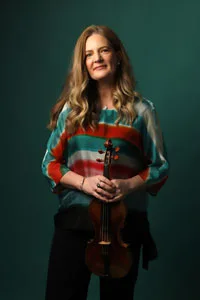
Directed by  Rachel Podger, violin

PROGRAMME

Jean-Baptiste LULLY
1632–1687
Suite from Roland
Ouverture – Air gay – Gavotte – Gigue – Chaconne
Charles AVISON
1709–1770
Concerto no. 6 in D Major, after Scarlatti
Largo – Con furia – Adagio – Vivacemente
Johann Sebastian BACH
1685–1750
Prelude and Fugue in E-flat Major, after BWV 552

INTERMISSION

Georg Philipp TELEMANN
1681–1767
Concerto for 2 oboes and bassoon in D Minor, TWV 53:d1
Grave – Allegro – Affettuoso Adagio – Vivace
Johann Sebastian BACH
1681–1767
Concerto for violin in G Minor, after BWV 1056
Allegro – Adagio – Presto
Rachel Podger, violin soloist
George Frideric HANDEL
1685–1759
Concerto grosso in G Minor, op. 6, no. 6
Largo affettuoso – A tempo giusto – Musette – Allegro –Allegro – Chaconne (from Terpsicore)

Rachel Podger, Principal Guest Director, violin

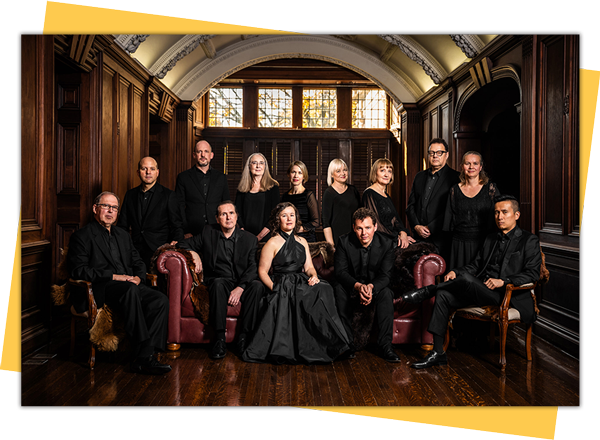
Tafelmusik Baroque Orchestra

Violin Rachel Podger, Patricia Ahern, Chloe Fedor, Johanna Novom,
Christopher Verrette, Julia Wedman, Cristina Zacharias
Viola Brandon Chui, Patrick G. Jordan
Violoncello Keiran Campbell, Michael Unterman
Double Bass Jussif Barakat Martínez
Oboe Daniel Ramírez Escudero, Marco Cera
Bassoon Dominic Teresi
Harpsichord Suren Barry

TAFELMUSIK BAROQUE ORCHESTRA

BRILLIANT BAROQUE

NOVEMBER 17, 2025 | 7:30 PM

 

Experience Canada’s world renowned Tafelmusik Baroque Orchestra celebrated for its authentic performances of Baroque repertoire, utilizing period instruments. Music by Handel, Avison, Telemannl, J.S. Bach and Lully will be performed.

Directed by Rachel Podger, violin

PROGRAMME

Jean-Baptiste LULLY
1632–1687
Suite from Roland
Ouverture – Air gay – Gavotte – Gigue – Chaconne

Charles AVISON
1709–1770
Concerto no. 6 in D Major, after Scarlatti
Largo – Con furia – Adagio – Vivacemente

Johann Sebastian BACH
1685–1750
Prelude and Fugue in E-flat Major, after BWV 552

INTERMISSION

Georg Philipp TELEMANN
1681–1767
Concerto for 2 oboes and bassoon in D Minor, TWV 53:d1
Grave – Allegro – Affettuoso Adagio – VivaceJohann

Sebastian BACH
1681–1767
Concerto for violin in G Minor, after BWV 1056
Allegro – Adagio – Presto
Rachel Podger, violin soloist

George Frideric HANDEL
1685–1759
Concerto grosso in G Minor, op. 6, no. 6
Largo affettuoso – A tempo giusto – Musette – Allegro –Allegro – Chaconne (from Terpsicore)

Rachel Podger, conductor, violin

What to wear? Be comfortable. Dress in a way that works for you. If you feel like dressing up, do it and you won’t be the only one, we promise. If you prefer to be more casual you will fit right in as well.

Beverages served prior to concert and during intermission. You can pre-order your beverage before the concert.


Mobile phones are allowed to be on but must be set to silent.


We welcome you to clap when you like what you hear.
Send Every Grade 4 Student to a VIS Concert
Help transform young lives through the power of music

Your donation can be the catalyst for transforming lives through the power of music.
Help us send every Grade 4 student to a VIS concert designed specifically for them.
The VIS Music Education program builds music appreciation and participation in
over 2,500 nine and  ten year old children each year.
Let’s welcome the symphony audiences of the future together!

DONATE

Click Here
Tafelmusik

Tafelmusik Artistic Co-Directors: Brandon Chui, Dominic Teresi, Cristina Zacharias

Every now and then a group of musicians comes along and changes the way we think about music. For over four decades, Tafelmusik has been synonymous worldwide with dynamic, engaging, and soulful performances informed by scholarship, passion, and artistic excellence. Performing on instruments and in styles appropriate to the era, Tafelmusik has performed in more than 350 cities in 32 countries. Its extensive discography on the Sony, CBC Records, Analekta, and Tafelmusik Media labels has garnered ten JUNOs and numerous international recording prizes. From a vibrant home season in Toronto, to international tours, award-winning recordings, and inspiring education programs, Tafelmusik is a musical powerhouse with a reputation for thrilling and delighting audiences.

tafelmusik.org

Tafelmusik Baroque Orchestra
Brilliant Baroque

Program Notes
By Charlotte Nediger

As Canada’s most toured orchestra, Tafelmusik’s music-making is enriched by the experience of sharing our passion with audiences far and wide. The concert hall is a natural home for a meeting of cultures, across borders and centuries, and this program was conceived with this is in mind. Principal Guest Director Rachel Podger brings delights from her native Britain by Handel and Avison. Avison in
turn shakes hands with Scarlatti in Spain, Lully takes us to the French theatre, Telemann welcomes us to northern Germany—and Bach inspires us with music that transcends time and place.

Lully Suite from Roland
We open the concert with music by the famous Music Director of the French court, Jean-Baptiste Lully, who arrived in Paris from his native Italy (Gianbattisa Lulli) as a teenager and went on to create a uniquely French style that influenced all of Europe. He spent much of his time in the theatre, penning opera-ballets teeming with orchestral music to accompany the dance. In France and abroad, orchestral suites were excerpted from these grand spectacles for performance outside the theatre: at court, for example, or in drawing rooms. In keeping with this tradition, we bring a selection of dances from Lully’s opera Roland to the modern concert hall.

Avison Concerto
The Newcastle-based British composer Charles Avison published several volumes of instrumental\ concertos and sonatas. Arguably his best work is found in his 1744 publication of Twelve Concertos based on harpsichord sonatas by Domenico Scarlatti. Originally from Naples, Scarlatti settled in Lisbon and Madrid, writing some 500 harpsichord sonatas for the Infanta Barbara of Portugal (later Queen of Spain). A selection of these sonatas was published in England in 1739 and enjoyed great popularity. Avison’s inventive transcriptions for string orchestra (each concerto is made up of four sonatas) were as popular as the original sonatas. They are charming works, a winning combination of Scarlatti’s flamboyance and Avison’s practical skill.

Bach Violin Concerto in G Minor / Prelude and Fugue
Bach was renowned in his day as an extraordinary keyboard player and left a wealth of music for harpsichord and organ. Three of his many harpsichord concertos survive in versions for violin: two for solo violin and one for two violins. It is clear that Bach wrote the violin versions first, later transcribing them for harpsichord as concert vehicles not only for himself, but also for his sons and gifted pupils. Which begs the question, what about the other harpsichord concertos? Are they transcriptions of violin concertos whose scores didn’t survive? It seems entirely plausible, and in this concert, we offer the possible original version of Bach’s F-Minor Harpsichord Concerto in a sort of reverse transcription.

The beautiful slow movement of the concerto also appears as the sinfonia to Bach’s Cantata 156, in this case featuring solo oboe. The piece can thus be heard in three soundscapes, with the harpsichord, violin, and oboe each offering a different perspective. Such an exploration of sound is the genesis for the other Bach transcription on the program, the Prelude and Fugue in E-flat Major, BWV 552. The two parts of this monumental work frame the third volume of Bach’s Clavier Übung, a series of four books of keyboard music self-published by Bach as a testament to his mastery of keyboard writing. In hearing a colleague play the work on baroque organ with its range of colours, Artistic Co-Director Dominic Teresi imagined how it might sound played by a baroque orchestra. The result is the transcription we are premiering on this tour.

Telemann Concerto for 2 oboes and bassoon
One of the most prolific composers of any time or place, Telemann had a particular affinity for writing for wind instruments. He was largely self-taught, taking up recorder, flute, and oboe, as well as several string instruments. Both resourceful and productive, he established a very successful career as composer and music director in Frankfurt and Hamburg. The libraries of baroque orchestras then and now contain multitudes of his concertos, suites, and chamber works for a range of orchestrations. The Concerto in D Minor is one of many works by Telemann scored for the core of the Tafelmusik Orchestra: two oboes, bassoon, strings, and continuo.

Handel Concerto grosso
Handel’s concerti grossi have been at the heart of Tafelmusik’s repertoire for over four decades. The Opus 6 collection of twelve concertos was published in London in 1739. The publisher took advantage of the public’s enthusiasm for Handel’s works by offering them by subscription: you could have individual concertos delivered as each was ready. Enthusiastic readings would have been heard in homes around the country. The nobly tragic opening movements of the sixth concerto melt into the centrepiece of the concerto, an extended pastoral Musette. The concerto was performed at a massive Handel Commemoration at Westminster Abbey in 1784: the 18 th -century writer Charles Burney noted that it was included because the Musette was “always in favour with the composer himself, as well as the public.” We end the concerto with a grand French-style chaconne by Handel written to accompany dancers in his opera-ballet Terpsicore—an homage to the Lully with which we began the concert, and a fitting end to our musical journey.